
Earlier this year, our quarterly research signaled that travel is becoming more emotionally essential, yet more complicated and financially scrutinized. We also saw early signs of a brand loyalty shift, with program participation dropping among lower-income households. But the industry has now been handed another stress test. Trade-policy uncertainty is clouding travel demand. Geopolitical conflict is adding fresh volatility to fuel costs. And the federal systems travelers rely on, security screening, airspace management, airport capacity are showing how little margin for error remains. This is no longer just a demand story. It is a resilience story.
The punchline is: Modern travelers are learning to live with significant unpredictability.
This social, economic, and political backdrop made now the right moment to pressure-test our findings. We went back into the field in April, surveying over 1,300 travelers to understand how consumers are actually navigating this moment. What we found wasn't panic; it was adaptation. People are protecting their trips, but how they book and what it takes to earn their loyalty has fundamentally shifted. That shift has real implications for every travel brand competing for their business.
Consumers are traveling despite chaos, but younger generations are doing it differently
While overall travel demand remains resilient, consumers are actively adjusting how they book travel to get around present-day friction. "Zillennials" (ages 25-34) are leading this charge: 54% have changed their booking habits to protect itineraries, compared to ~46% of Gen Z and just 35-39% of travelers 45 and older. The generational split reveals a contrast in flexibility.
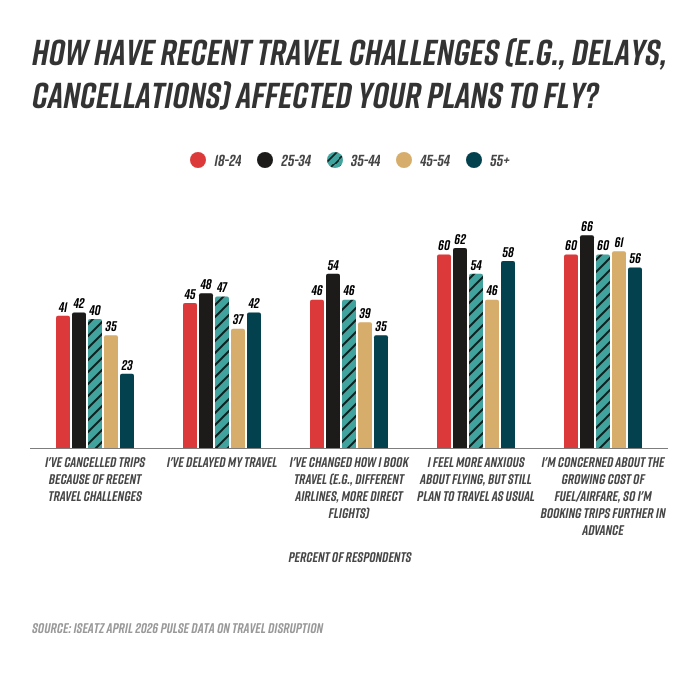
To cope with the growing costs of fuel and airfare, 60% of all travelers say they are booking trips further in advance. But again, Zillennials overindex here with 66% booking further out, demonstrating a higher rate of proactive planning than any other generation, which was somewhat surprising to me.
When someone starts planning months in advance, absorbing anxiety and cost pressure the whole way, that sustained effort deserves to be met with something more durable than a transaction. But our survey revealed a key tension: are loyalty programs, as they're currently designed, built to recognize that kind of commitment, let alone reward it?
When travel gets harder, loyalty is in jeopardy
At the exact moment travelers are investing more emotionally, financially, and logistically in making trips happen, loyalty programs are becoming harder to access, not easier.
- The income divide is widening: Our data indicates that participation in loyalty programs drops significantly among lower-income households, with 33% of households under $50K opting out entirely. In contrast, high-frequency, high-earning travelers are moving in the opposite direction: only 8-9% of households earning over $200K opt out.
- High-earners are gamifying the system: More than a third of $300K+ households said that they identify as strategic, multi-program users, treating loyalty like a financial asset they can leverage through premium credit cards and high-volume travel. But for the average consumer, the financial commitment required to unlock meaningful perks may not be possible.
- Consumers are noticing the imbalance: 25% of all consumers explicitly stated they feel these systems reward spending power rather than actual loyalty. The data on what travelers actually wish their programs offered adds texture to that frustration—the most commonly cited desires were about access and fairness:
- 27% want to use points without blackout dates or restrictions
- 25% want rewards that are easy to redeem, without excessive hoops
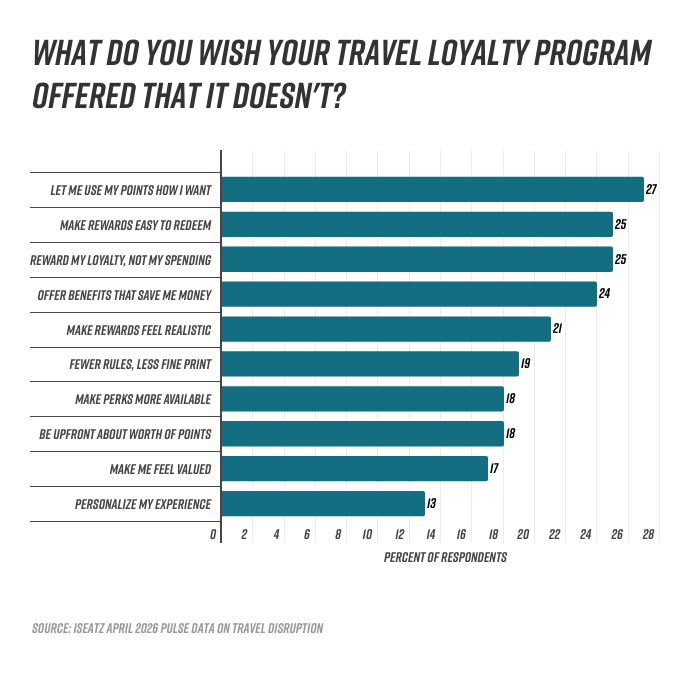
What travelers are describing is a critique of structural inaccessibility. The programs exist. The points accumulate. But the moment of actual redemption keeps receding, and as a result:
- Younger demographics are stepping away from brand allegiance: 46% of Gen Z and 38% of Zillennials immediately default to the cheapest option over a preferred brand. They are prioritizing immediate cost savings over future perks.
- High-frequency travelers (5+ trips a year) are doubling down: 44% report becoming more loyal to their preferred brands. Because they aren't bogged down by the same financial friction, they are better able to leverage frequent travel and high spend to unlock premium rewards that casual travelers can no longer reach.
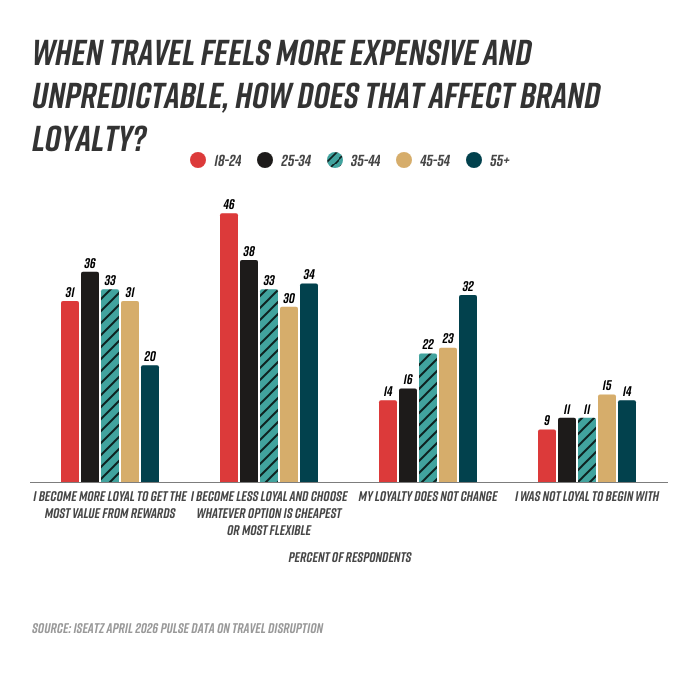
Brand devotion hasn't disappeared, but it is no longer the automatic byproduct of a loyalty program's existence. The data suggests that loyalty programs are increasingly functioning as financial instruments that reward expertise over affinity. That works exceptionally well for a narrow segment of high-frequency, high-income travelers. For the broader market, it is quietly breeding disengagement. If this gap continues to widen, loyalty programs may no longer serve as the reliable retention tools they once were.
Travelers are adapting. Is the industry?
Despite stress and uncertainty, travelers aren't walking away from travel. They're walking away from the parts of the travel experience, including loyalty programs, that aren't meeting them where they are.
At a moment when consumers are booking earlier, budgeting harder, and carrying more emotional weight into every trip they take, the industry should be asking: what would it look like for loyalty to provide value at the exact moment a traveler actually needs it, rather than six months and ten flights down the road? We'll keep digging into those questions as we continue tracking the evolving travel landscape throughout 2026.
Want more news and insights from iSeatz? Sign up for our newsletter!

To learn more about our work in travel technology, contact us here.