

A few years ago, trusting your vacation plans to an AI tool felt like a novelty act. Today, it's inching toward a genuine expectation, at least for some travelers.
We surveyed 1,000 U.S. travelers to gauge their comfort in leveraging AI through the travel planning and booking process. What we found is that traveler trust in AI is real, but it's also conditional. It doesn't arrive all at once. It builds task by task, and it accelerates dramatically when the value is tangible.
While unsurprising, this insight is critical for travel brands. If you expect consumers to trust your brand and underlying AI, that technology needs to add something meaningful to the planning or booking experience, whether that’s savings, personalization, or another value-add.
Today, trust stalls at the booking button
Travelers are cautiously optimistic about AI's role in travel. 20% say it will make the experience significantly easier, and another 28% describe themselves as open but cautious.
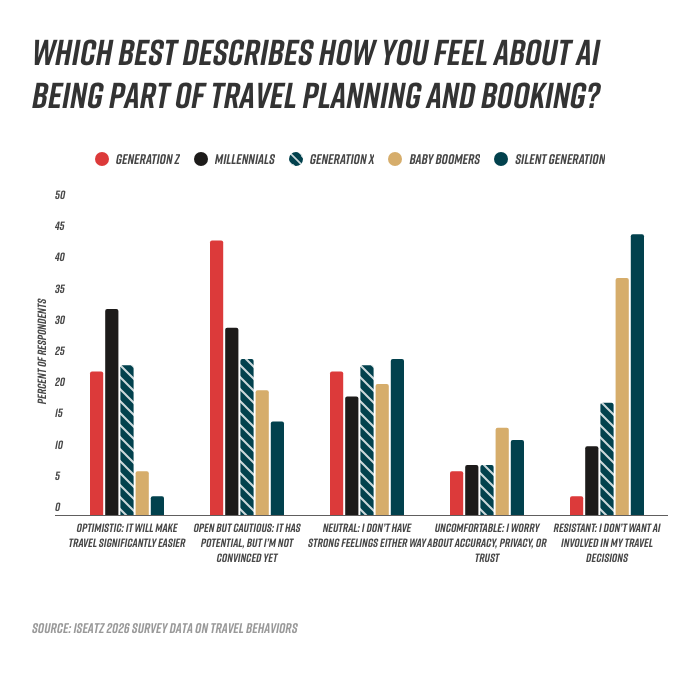
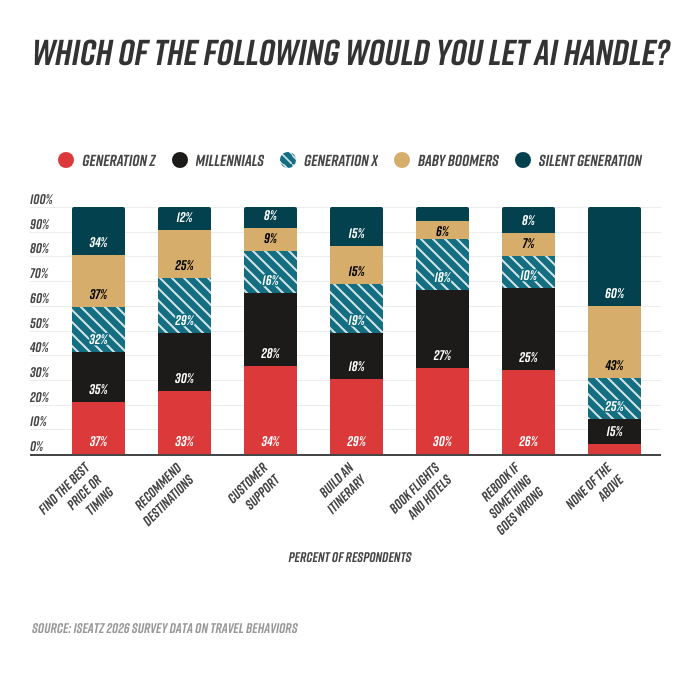
Comfort with AI in travel isn't fixed. It shifts significantly depending on the task. Travelers are most at ease with AI in advisory roles: 35% of travelers are comfortable letting AI find the best price or timing, and 28% are comfortable with destination recommendations. These are relatively low-stakes interactions. AI offers input, the traveler decides.
But comfort drops sharply the moment AI moves toward execution. Only 19% are comfortable letting AI book flights and hotels on their behalf. A full 26% say they wouldn't let AI handle any of the tasks we asked about.
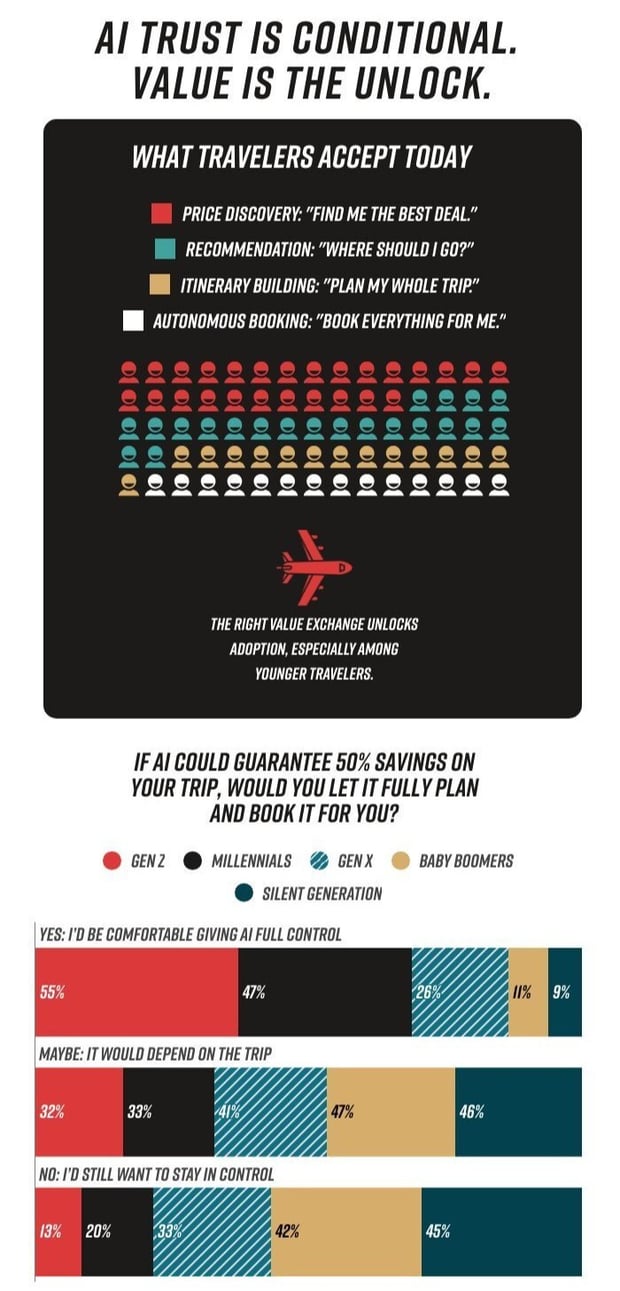
Though travelers are more likely to accept AI as an advisor than as an active agent, that reluctance isn't permanent or philosophical. It's contingent. When we introduced a concrete value proposition into our question (“Would you let AI fully plan and book your trip if it could guarantee 50% savings?”), willingness to let AI book for the traveler jumped to 31% overall - 47% among Millennials, and 55% among Gen Z.
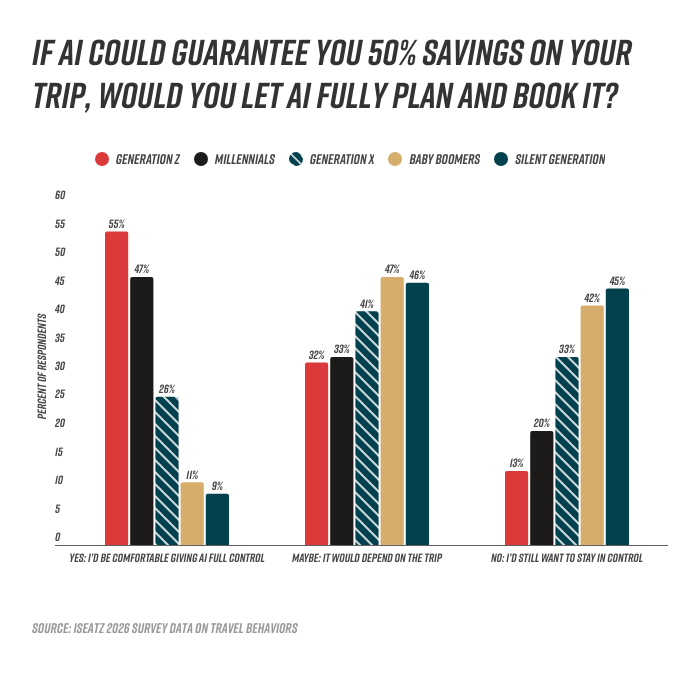
That's a significant shift, and it tells us something important: the barrier to AI adoption in travel isn't that people don't trust technology at all. It's that they haven't yet seen enough proof of what AI can deliver. Cost savings are a powerful lever, but they’re illustrative of a broader principle. When AI demonstrably saves time, surfaces a better deal, prevents a disruption, or unlocks a loyalty benefit that would otherwise go unrealized, the calculus will change. Real, felt value can move people from cautious to accepting.
Building experiences with AI in mind
- Start where trust already exists, then earn more. Price discovery, destination ideas, itinerary inspiration – travelers are already comfortable here. Nail these consistently, and the willingness to hand over more will follow.
- Make the value exchange concrete. Abstract AI value won’t convert skeptics. Providing better options, especially options that align with personal preferences, is what can bring confidence to travelers.
- The opportunity isn't limited to the early adopters. Most travelers describe themselves as "open but cautious." They don't want AI to take the wheel; they want AI to propose and stay out of the way until asked. Build for that: suggest, explain, and always let them override.
Trust is built in the small moments
Every price discovery that saves money, every insight that surfaces a benefit the traveler would have missed, every rebooking that happens before they even have to ask, helps build trust in AI tools.
The brands that earn travelers’ trust in AI tools in the small moments will be the ones they turn to when the stakes and the possibilities get bigger.
Want more news and insights from iSeatz? Sign up for our newsletter!

To learn more about our work in travel technology, contact us here.